
WITHOUT POWER? NOT YOUR FAULT… BUT YOUR BEST IS STILL NOT ENOUGH.
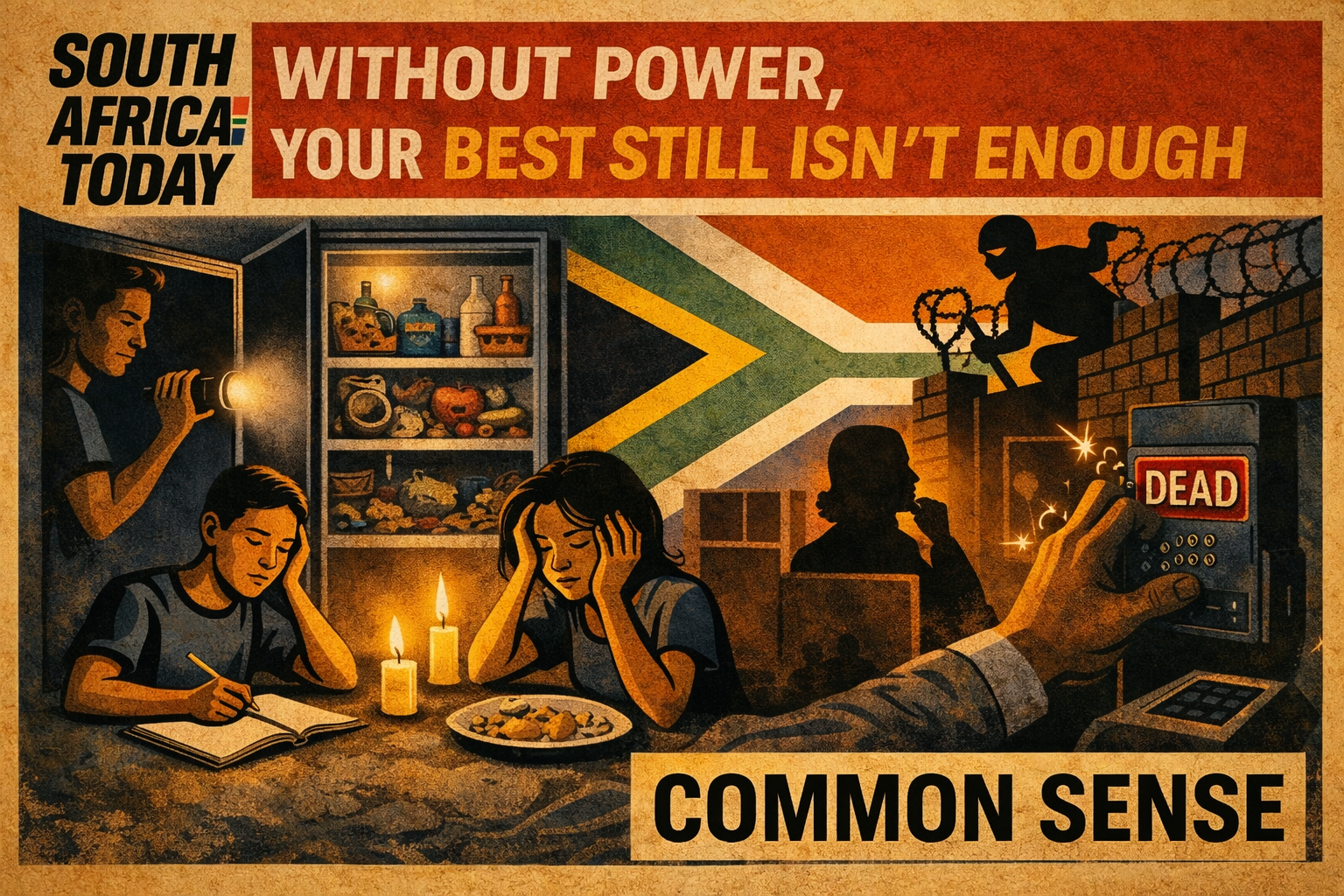
Every time the lights go out in South Africa, somebody in a nice office says something bloodless about constraints, maintenance, capacity, pressure, backlog, or an “unplanned interruption.” Fine.
Let them say it.
But inside a real house, where the fridge starts sweating and the gate motor gives attitude and a child is trying to finish homework before the battery lamp dies, everybody knows what has actually happened. A bill has arrived.
That is the part of this story we still refuse to name properly. We speak about load shedding as if it is a timetable issue, a technical event, a national nuisance. We count stages. We count megawatts. We count units offline. But common sense says the real experience of power instability is not technical at all. It is domestic. It comes through the wall and straight into the kitchen, the bedroom, the school bag, the medicine shelf, the front gate, the till, the street outside. It does not ask permission. It collects.
That is why I keep calling it a tax.
Not because it sounds clever. Because it is the cleanest word for a recurring extraction. Something taken from you again and again, whether you voted for it or not, whether your budget can handle it or not, whether your home was already stretched thin or not. A tax is a burden imposed from above and paid below. That is exactly how this thing now behaves. It takes groceries. It takes sleep. It takes time. It takes calm. It takes order. It takes the basic feeling that a normal home can still run like a normal home.
Stats SA’s General Household Survey 2023 found that 77.5% of households experienced load shedding every day. Daily. Not from time to time. Not only in a rough patch. Daily. Once a problem enters daily life, it stops being a disruption and starts becoming a condition. Families are no longer reacting to an exception. They are living inside a failing operating environment. That is when the whole household begins to reorganise itself around the damage. You buy differently. You cook differently. You charge differently. You sleep differently. You plan differently. Eventually, you even expect less. And when that happens, the cost stops arriving as drama and starts arriving as wear.
One freezer drawer gone soft. One extra trip because the robots were out and traffic was chaos. One router dead. One gate stuck half-open. One work call dropped. One dinner delayed. One old person unsettled because the street is too dark again. One child ratty because the room was hot for hours and the fan never came back on.
None of those losses looks big enough on its own to feel like a national disgrace. That is exactly why the disgrace survives. It hides in fragments. It looks like nuisance until you tot it up, until you see how many homes are bleeding a few hundred rand at a time, month after month.
An IOL Business Report piece, citing Debt Rescue survey findings, reported that 93% of South Africans had thrown away spoiled food during outages and 38% had replaced refrigerators because of load shedding damage. Think about that properly. Nearly everybody knows what it is to open the fridge after an outage and realise money has turned into rubbish. Over a third know what it is to lose the machine that keeps the household rhythm intact in the first place. A fridge is not some lifestyle flourish. It is one of the anchors of domestic order. When it goes, the cost is not only financial. It is logistical. Emotional too. It tells the whole house that the basics are no longer basic.
That is the dirty trick of this tax. It is levied on the ordinary.
It is levied on the parent trying to keep lunch boxes sorted and supper safe. On the goggo whose medicine needs refrigeration. On the shift worker sleeping in broken chunks because the alarm battery is moaning and the room never cooled down. On the person working from home who is expected to stay “flexible” while the Wi-Fi dies, the laptop runs low, and every meeting becomes a little act of pretending this is all manageable. On the spaza operator or small trader who cannot keep stock cold, cannot keep systems running, cannot keep replacing burnt equipment, and cannot exactly send Treasury an invoice. And because these losses arrive in bits and pieces, people start swallowing them as if they are signs of private failure.
The groceries look thinner. The house feels more strained. The timetable gets patchy. Someone starts moralising. Budget better. Plan better. Stop complaining. Make a plan. Be tougher. Ag please.
A plan is not the same thing as infinite absorption. There is a point at which a home is no longer “coping” so much as quietly subsidising failure from above.
Common sense says a functioning home is not held together by virtue alone. It is held together by systems. Light. Cold storage. Connectivity. Hot water. Pumps. Security. Predictability. Routine. The boring infrastructure beneath ordinary dignity. Once those things become unreliable, a household starts paying merely to remain recognisable to itself. That is why the electricity story is never just about electricity. It is about what happens when the layer beneath daily life starts giving way.
And some households pay far more than others.
That matters, morally and politically. A comfortable household can buy buffers. An inverter. A UPS. A generator. Solar. Better surge protection. More batteries. More data. A chest freezer. More slack in the budget. Moneyweb reported that Santam saw personal-lines power-surge claims rise 37% in 2022 while more households spent on inverters, UPS devices, generators, portable batteries and solar. That tells us damage is real. It also tells us that people with means are buying distance from the worst of the crisis. They are paying to step out of the queue.
But the township household, the rural household, the family already stretching every rand, does not meet the same menu of options. An academic paper on the environmental health impact of rolling blackouts in South Africa notes that poorer households are especially vulnerable to spoiled food, damaged appliances and health harms during prolonged outages. That tracks with common sense. When the lights go off, the poor are not hit by a concept. They are hit by raw exposure. Less backup. Less spare cash. Less room for one more repair, one more replacement, one more week of buying around the failure. The same outage does not mean the same thing in Sandton as it does in a township, on a farm, or at a rural clinic. That is how inequality deepens without always looking dramatic. It hides inside coping capacity.
Then there is the street. Let us not lie about that either. Darkness changes behaviour. It changes who feels safe, who feels trapped, who feels watched, and who sees a gap. DefenceWeb reported that robberies rose alongside the worst power outages of 2022 and quoted security concerns that criminals were exploiting compromised home and business systems during outages. Well, obviously. No lights. Weak alarms. Electric fencing interrupted. Neighbours pulled inside. Whole stretches of suburb and township easier to move through unseen. Criminals do not need a government briefing to recognise opportunity. They clock it immediately.
So the tax is not only financial. It is psychological. It taxes calm. It taxes the feeling that the front gate, the perimeter, the room where your child is sleeping, the old person down the passage, the whole house really, are being held inside a working protective order. When that order thins, households compensate. They add locks. They charge torches. They buy solar lights. They double-check the gate. They listen harder at night. They sleep lighter. Again: that is a tax. A recurring charge on peace of mind.
BusinessTech, using EskomSePush analysis in early 2023, reported that while load-shedding rotations were in effect for an average of 22.9 hours a day, actual blackout time experienced averaged around 6.2 hours daily. Six-point-two hours. Nearly a quarter of the day. You cannot strip that much operating time out of a country, day after day, and still pretend the consequences are marginal. Six hours of interrupted work. Six hours of weakened security. Six hours of dead robots, hot rooms, staggered meals, delayed charging, missed online learning, broken routine, and those petty humiliations unique to South Africa: being told to act as though this is just another inconvenience, as though the whole country is not being trained to live smaller.
Ja, South Africans adapt. We always do. We are brilliant at making a plan. But adaptation is not free.
That is another one of the cons in this whole story: the same people who praise resilience rarely mention what resilience costs. Surge protectors cost money. UPS devices cost money. Diesel costs money. Extra data costs money. Replacing batteries costs money. Even the advice to “prepare better” assumes spare room, spare time, spare cash, spare emotional margin. Not everybody has that. In plenty of homes, preparation itself becomes another bill.
And when the broader economy is weakening alongside the household, the pressure compounds. TimesLIVE reported Energy Minister Kgosientsho Ramokgopa citing a South African Reserve Bank estimate that each stage of unmet electricity demand could strip around R300 billion out of the economy and contract GDP by roughly 5%, with hundreds of thousands of jobs already lost or at risk. Big numbers go soft in the mind after a while, but their household meaning is simple enough: thinner labour markets, weaker wages, harder trade-offs, less room to absorb the next shock, less ability to buy your way clear of the mess.
That is why I reject the polite lie that power instability is merely a technical issue. No. It enters the body. It enters the budget. It enters the timetable. It enters the marriage, the parenting, the fear, the sleep, the whole way a family imagines next week. If every improvement can be interrupted, why fix the next thing now? If the fridge may go again, why buy certain food? If the outage will hit in the middle of work, why promise too much? If the system keeps taking its slice, how do you stop your standards shrinking to fit the damage?
That is the deeper theft. Instability does not only take goods. It takes expectation. It teaches people to plan shorter, hope smaller, delay more, accept less.
Not because they are weak. Because repeated interference changes the psychology of effort itself. A failing system does not only break appliances. It teaches people not to trust continuity.
That is why the language matters. I do not want households spoken to as if every visible sign of strain is a character flaw. Too much of our public conversation still slides into that cruelty. If a family is battling, somebody wants to lecture. If the food went off, somebody says plan better. If the child studies under a torch, somebody says be more disciplined. If the house looks tired, somebody says take more pride. No. Some losses are not moral failures. Some losses are system failures landing indoors.
That does not erase agency. It simply tells the truth about the conditions under which agency is being exercised. Once you admit that, the common sense changes. Backup stops looking paranoid. Buffering stops looking indulgent. Preparation stops looking eccentric. Community coordination stops looking old-fashioned. They start to look like rational responses to an unfair levy.
But let us not romanticise coping too much. The burden should never have been shifted this far down in the first place. South Africans are being asked not only to endure instability, but to privately finance its consequences over and over again. In groceries. In repairs. In batteries. In insurance claims. In stress. In interrupted study. In fear. In lowered expectations. The bill is disguised as inconvenience, but it behaves like extraction.
And the longer this goes on, the more dangerous the soft language becomes, because euphemism is how a country learns to treat damage as fate. Call it a challenge for long enough and people stop asking who is benefiting from their adjustment. Call it a disruption for long enough and people forget that somebody, somewhere, is externalising the cost straight into the home. Call it an inconvenience for long enough and the household starts blaming itself for not carrying the load more gracefully.
That is the real common-sense point. Families are being billed for failures above them.
They are paying in fragments, which is why the country finds it so easy to normalise the thing. But a bill collected in fragments is still a bill. A tax collected quietly is still a tax. And every time the lights go out, South Africa reveals the same hard hierarchy again: who can buy relief, who has cover, who has buffers, and who is left standing at the till, paying for a system that keeps handing them the invoice.
