
Majority rule under question: This is NOT what we were promised.
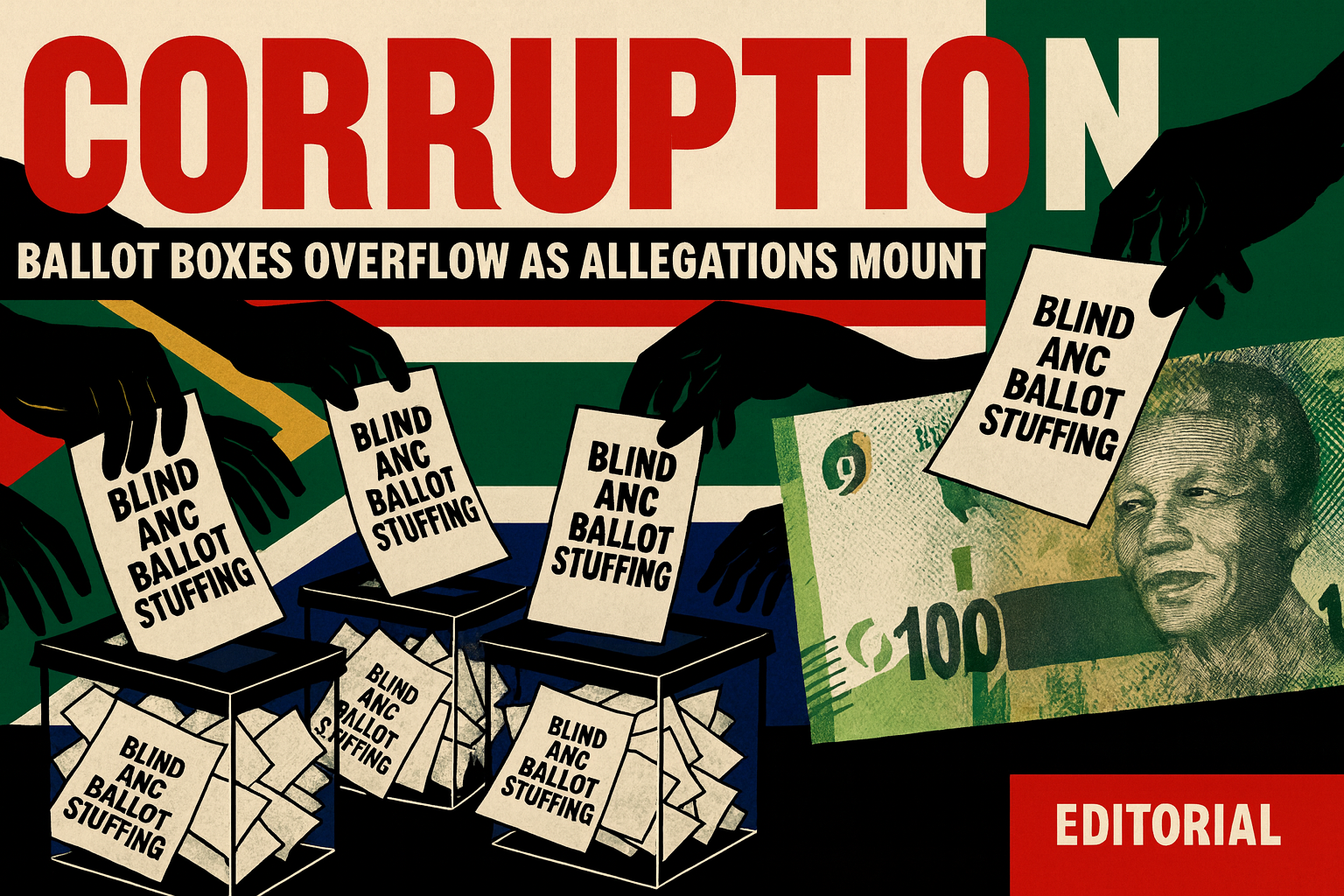
South Africa did not wake up one morning and suddenly “discover” corruption. It crept in slowly, the way damp creeps into an old Cape house — quietly at first, almost easy to ignore, until one day the walls are stained and you realise the whole structure has been sitting in moisture for years. A dodgy tender here, a politically convenient appointment there, a boardroom decision that makes you pause and ask: but who exactly is this oke, and why is he suddenly in charge of billions?
The real story of corruption in South Africa is not that scandals exist. Every country has them. The real question is why the scandals became so stubborn — why they could survive outrage, newspaper exposés, parliamentary shouting matches, commissions of inquiry and court rulings, and still keep surfacing again and again. The uncomfortable answer is not that democracy itself is broken. The deeper problem is something narrower and more dangerous: when one party governs for too long without meaningful competition, the accountability that democracy relies on begins to weaken. Parliament stops behaving like an oversight body and starts acting like a shield. Procurement systems bend under political pressure. Oversight becomes performative rather than real. Elections still happen and constitutions still exist, but the gears that keep the machine honest begin grinding down.
For decades the African National Congress held such overwhelming political dominance that the incentives of democratic accountability began to change. It did not happen overnight. It happened gradually, through a culture of cadre deployment, patronage networks, and institutional complacency. When a party knows it will almost certainly win the next election, the political risk of failure begins to shrink. And when that risk shrinks, standards can slip. Yet South Africa’s corruption story has another side — one that complicates the narrative. The same democratic system that allowed corruption to grow also produced the institutions that exposed it. Courts intervened. Investigative journalists dug into contracts and emails. Civil society organisations went to court. Commissions of inquiry forced witnesses to testify under oath. Eventually voters themselves began to shift the political landscape.
The result is a country that has spent nearly a decade publicly dissecting its own political decay.
State capture: corruption as a system, not an accident
The modern corruption narrative reached a turning point in 2016 with the explosive Public Protector report titled State of Capture. The investigation examined allegations that former president Jacob Zuma and senior officials had maintained improper relationships with the business network associated with the Gupta family. The report suggested that the Guptas had exerted influence over cabinet appointments, steered decisions at state-owned enterprises, and secured lucrative government contracts through political connections. It did something crucial: it transformed corruption from political gossip into documented allegations supported by evidence.
That report led directly to the establishment of the landmark inquiry that would dominate South African politics for years — the Zondo Commission chaired by Chief Justice Raymond Zondo. The commission spent four years investigating what became known as “state capture”, a phrase that now sits permanently in the country’s political vocabulary. Witnesses described how political power, procurement systems and business interests had become entangled in ways that allowed public resources to be diverted for private benefit.
The numbers are staggering. Over four years the commission heard testimony from more than 300 witnesses during hundreds of days of hearings and examined roughly 1.7 million pages of evidence. Investigators estimated that around R57 billion in public spending had been tainted by corruption linked to state capture, with the bulk of that money flowing through two massive state-owned enterprises: Eskom and Transnet. What emerged from the hearings was not a handful of rogue officials but a pattern — a system in which appointments, contracts and oversight mechanisms could be manipulated. Investigators described how law-enforcement agencies had been weakened, how procurement rules had been bypassed, and how parliamentary oversight had often failed to intervene.
In other words, corruption had become institutional.
Nkandla and the moment the courts stepped in
One of the earliest and most symbolic moments in the corruption saga came from the Nkandla controversy. The issue centred on public funds spent on upgrades to Jacob Zuma’s private residence in rural KwaZulu-Natal. Investigations revealed that millions of rand had been spent on features that critics argued had little to do with security. When the matter reached the Constitutional Court, the judges delivered a unanimous ruling with profound implications. The court confirmed that the findings of the Public Protector were binding unless overturned by a court of law. It concluded that both the president and Parliament had failed to fulfil their constitutional duties by ignoring those findings. Zuma was ordered to repay a portion of the public money spent on the property.
The legal significance went far beyond one scandal. The ruling showed that Parliament — dominated by the governing party — had failed to hold the executive accountable, forcing the judiciary to step in. For many South Africans it was a turning point. It demonstrated both the vulnerability and the resilience of the constitutional system.
Transnet: corruption on an industrial scale
If Nkandla revealed political protection, the saga around Transnet exposed the enormous financial scale of state capture.
Transnet sits at the heart of South Africa’s freight rail and logistics infrastructure. During the state-capture years it also became one of the central channels through which corrupt procurement allegedly flowed. One of the most controversial deals involved a massive locomotive procurement programme worth more than R50 billion. Investigators later alleged that contracts were inflated, intermediaries were paid enormous commissions, and politically connected individuals exerted influence over the tender process.
Years later, the clean-up process is still underway. Courts have begun setting aside contracts linked to the procurement programme, including an R8 billion locomotive contract invalidated by the High Court. Criminal investigations are continuing, with prosecutors pursuing cases against former executives and officials. The lesson from Transnet is sobering: when corruption embeds itself inside large procurement systems, undoing the damage can take longer than the corruption itself.
Eskom: when corruption hits the lights
Few scandals illustrate the real-world impact of corruption better than those surrounding Eskom.
South Africa’s electricity utility has struggled with debt, failing infrastructure and rolling power cuts known as load-shedding. For businesses, households and informal traders alike, the outages are more than an inconvenience. They affect livelihoods. Investigations suggest that corruption played a role in weakening the utility’s finances and governance. Authorities have been examining multiple contracts linked to coal procurement and IT systems, including deals involving politically connected suppliers.
Among the allegations are controversial prepayments amounting to billions of rand made to coal companies during the state-capture era. Prosecutors continue to investigate contracts related to the construction of major power stations, including Kusile. For the public, the technical details matter less than the outcome. The lights go out, and the country pays the price.
Digital Vibes and the reminder corruption didn’t vanish
One of the more uncomfortable truths about South Africa’s corruption crisis is that it did not end when Jacob Zuma left office.
The Digital Vibes scandal, which emerged during the COVID-19 pandemic, involved irregular procurement linked to communication campaigns for the national health department. Investigators concluded that contracts worth roughly R176 million were awarded through processes that involved conflicts of interest and irregularities.
The scandal forced the resignation of a cabinet minister and served as a reminder that corruption was not confined to a single political era. The patronage culture that developed during the state-capture years did not disappear overnight.
Bosasa: corruption on a personal level
Not all corruption involves massive infrastructure contracts. Sometimes it operates through relationships, favours and influence.
The Bosasa case, examined in detail during the Zondo Commission, illustrated what investigators described as a “retail” model of corruption. Company executives allegedly cultivated political relationships through gifts, donations and personal benefits while securing lucrative government contracts.
Testimony suggested that these networks of influence allowed corruption to persist quietly for years.
The scandal demonstrated that corruption could operate both through massive procurement manipulation and through more subtle forms of political patronage.
Municipal collapse and everyday consequences
While national scandals dominate headlines, the real impact of corruption is often felt at local level.
Across South Africa residents deal with failing water infrastructure, broken roads, unreliable refuse collection and collapsing municipal finances.
Audit reports from Auditor-General South Africa paint a bleak picture. Only a small portion of municipalities achieve clean audits each year, while many rely heavily on consultants simply to prepare financial statements.
Billions of rand have been spent on external consultants, yet errors in municipal accounts remain widespread.
For residents the result is visible in potholes, water outages and deteriorating public services. Corruption stops being an abstract national debate and becomes a neighbourhood problem.
Dominant-party rule and the accountability problem
Political researchers have long warned about the risks of dominant-party systems. Studies from the Electoral Institute for Sustainable Democracy in Africa highlighted how overwhelming electoral dominance can weaken responsiveness and reduce accountability. Later research published through Cambridge University Press found that politicians respond strongly to electoral competition. Where a ruling party faces real competition, performance improves. Where electoral margins are large, accountability tends to weaken.
In plain South African terms: when politicians believe they cannot lose, they stop behaving as if voters matter.
Public trust is eroding
Public opinion surveys reflect growing frustration.
Research by Afrobarometer shows that support for democracy and satisfaction with democratic performance have both declined significantly over the past decade. Many South Africans believe corruption is widespread among political leaders, and trust in Parliament has fallen sharply. When citizens lose faith in elected representatives, democracy itself begins to feel distant.
The 2024 election shock
The political consequences became visible in the 2024 national election. For the first time since the end of apartheid, the ANC failed to secure an outright majority. According to the Independent Electoral Commission of South Africa, the party won just over 40 percent of the national vote. The result did not remove the ANC from power, but it ended the era of automatic parliamentary dominance. For analysts it signalled something important: South African voters were beginning to reintroduce competition into the political system.
The paradox of South African democracy
The past decade reveals a paradox. Democracy allowed corruption to expand under prolonged dominant-party rule. Yet democracy also exposed it. Courts intervened. Investigative commissions documented wrongdoing. Civil society organisations forced accountability. Voters eventually reduced the ruling party’s dominance. South Africa’s political system bent under pressure — but it did not break.
What comes next?
The deeper lesson from South Africa’s corruption crisis is not that democracy has failed. It is that democracy without competition becomes fragile. When one party dominates politics for too long, internal party dynamics can replace public accountability. Patronage networks flourish. Oversight weakens. Rebuilding accountability requires more than removing individual politicians. It requires strengthening institutions, reforming procurement systems, protecting watchdog bodies and ensuring elections remain competitive.
South Africa’s experience does not prove that democracy is inherently flawed…
What it demonstrates is something subtler but equally important. Democracy without competition becomes fragile. When one party dominates politics for decades, oversight weakens, political careers depend more on internal party dynamics than on public performance, and corruption finds room to grow. Restoring accountability requires more than removing individual politicians. It requires strengthening institutions, enforcing procurement rules, protecting watchdog agencies, and ensuring elections remain genuinely competitive. The country has spent years exposing corruption.